

| # A simple comparison | |
| In this experiment we generated one thousand C files with contents | |
| that looked like this. | |
| ```c | |
| #include<stdio.h> | |
| #include"header.h" | |
| int func23() { return 0; } | |
| ``` | |
| The function number was different in each file. In addition there was | |
| a main C file that just called each function in turn. We then | |
| generated build system files for *Meson*, *CMake*, *SCons*, *Premake* | |
| and *Autotools* that compiled these files into a single executable. | |
| With this we measured three different things. The first is | |
| configuration time, that is, the time the build system takes to | |
| generate necessary build files. This is usually called the *configure | |
| step*. The time was measured in seconds. | |
| The second thing to measure was the build time. This should be limited | |
| by the compiler and in the optimal case should be the same for every | |
| build system. Four parallel processes were used in this test. | |
| The third thing we measured was the empty build time. This measures | |
| how much time the build system takes to check the states of all source | |
| files because if any of them could potentially cause a rebuild. | |
| Since CMake has two different backends, Make and Ninja, we ran the | |
| tests on both of them. All tests were run on a 2011 era MacBook Pro | |
| running Ubuntu 13/04. The tests were run multiple times and we always | |
| took the fastest time. | |
| Here are the results for configuration time. | |
|  | |
| The reason SCons got zero seconds on this test is because you cannot | |
| separate configure and build steps. They run as one unit. Autotools is | |
| the clear loser of this test as it is over an order of magnitude | |
| slower than the second slowest one. This configuration time includes | |
| both autogen and configure. All other systems take less than one | |
| second to do this setup, which is fast enough for a human being to | |
| interpret as instantaneous. | |
| 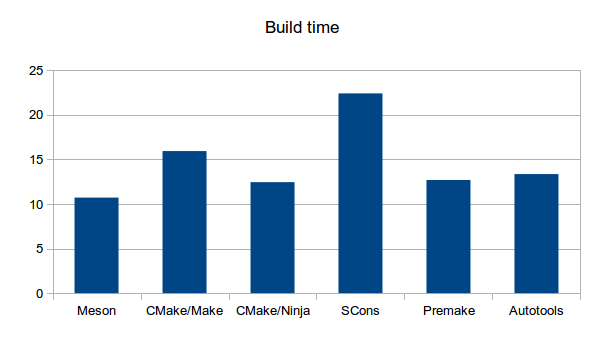 | |
| Build times are a bit more even. SCons is the slowest, being almost | |
| ten seconds slower than the second slowest. Some of it is work from | |
| the configure step but it still has the worst performance. Premake is | |
| the fastest Make-based build system narrowly beating out Autotools. | |
| Both Ninja-based build systems are faster than all non-Ninja ones with | |
| Meson being slightly faster. In practice the difference is minimal. | |
| The advantages of Ninja can be seen by comparing CMake's times when | |
| using Make or Ninja. It is possible to shave off 3.5 seconds (over | |
| 20%) of the total build time just by changing the backend. The | |
| project's CMake configuration files don't need any changes. | |
| 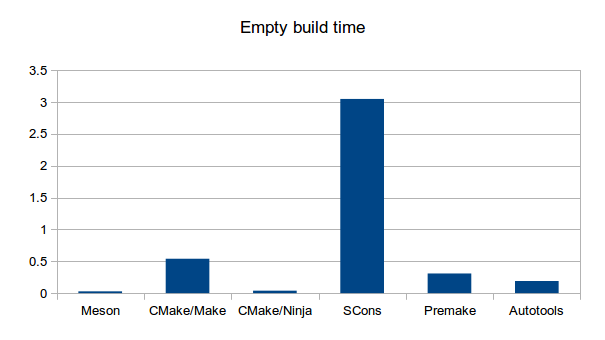 | |
| Empty build times reflect the performance of regular build times. | |
| SCons is again the slowest taking over three seconds compared to | |
| Meson, which takes only 0.03 seconds, a difference of two orders of | |
| magnitude. Even Autotools, the fastest Make-based system, is almost | |
| one order of magnitude slower. Ninja holds the top spots just like in | |
| the previous test. | |
| Conclusions | |
| ----- | |
| Build system performance matters. Even with this extremely simple | |
| example we can find differences between various popular build systems. | |
| As the project size increases, these differences grow even larger. | |
| (The author has witnessed no-op build times of 30 seconds for Make | |
| versus less than one second for Ninja when compiling the Clang | |
| compiler.) Keeping incremental build times low is one of the major | |
| keys of programmer productivity as it allows developers to iterate | |
| faster and stay in the creative zone. | |
| Original scripts | |
| ----- | |
| Those who want to run these experiments themselves can download the scripts here: | |
| * [Generator script](https://raw.githubusercontent.com/wiki/jpakkane/meson/gen_src.py) | |
| * [Measurement script](https://raw.githubusercontent.com/wiki/jpakkane/meson/measure.py) |