
| # **Platform Runtime Mechanism** | |
| Platform Runtime Mechanism (PRM) introduces the capability of moving platform-specific code out of SMM and into a | |
| code module that executes within the OS context. Moving this firmware to the OS context provides better transparency | |
| and mitigates the negative system impact currently accompanied with SMM solutions. Futhermore, the PRM code is | |
| packaged into modules with well-defined entry points, each representing a specific PRM functionality. | |
| For more details on PRM, refer to the [Platform Runtime Mechanism Specification on uefi.org](https://uefi.org/sites/default/files/resources/Platform%20Runtime%20Mechanism%20-%20with%20legal%20notice.pdf). | |
| The `PrmPkg` maintained in this branch provides a single cohesive set of generic PRM functionality that is intended | |
| to be leveraged by platform firmware with minimal overhead to integrate PRM functionality in the firmware. | |
| > By default, the build makes use of a new ACPI OperationRegion type specifically introduced for PRM called | |
| `PlatformRtMechanism`. Support for this OperationRegion is planned for the next release of the ACPI specification. | |
| However, support for `PlatformRtMechanism` is already included in the iASL Compiler/Disassembler for early prototyping | |
| (i.e. this package). If you would like the default build to work and/or to use PRM handlers that are invoked | |
| through ACPI, iASL compiler [20200528](https://www.intel.com/content/www/us/en/download/774849/774861/acpi-component-architecture-downloads-previous-releases-2020.html) | |
| or greater must be used. If you are only interested in compiling the code and/or using direct call style PRM | |
| handlers, you can simply remove `PrmSsdtInstallDxe` from `PrmPkg.dsc`. | |
| The changes in the ACPI Specification include two elements: | |
| 1. `BIT20` in Platform-Wide _OSC Capabilities DWORD2 will be used by an OS to indicate support for PRM | |
| 2. A new Operation Region Address Space Identifier Value is defined as `0xB` for `PlatformRtMechanism` | |
| ## How to Build PrmPkg | |
| As noted earlier, resources in `PrmPkg` are intended to be referenced by a platform firmware so it can adopt support | |
| for PRM. In that case, the platform firmware should add the `PrmConfigDxe` and `PrmLoaderDxe` drivers to its DSC and | |
| FDF files so they are built in the platform firmware build and dispatched during its runtime. All that is left is to | |
| add individual PRM modules to the DSC and FDF. These can be built from source or included as binaries into the platform | |
| firmware flash map. | |
| ### PrmPkg Standalone Build | |
| To build `PrmPkg` as a standalone package: | |
| 1. If new to EDK II, follow the directions in [Getting Started with EDK II](https://github.com/tianocore/tianocore.github.io/wiki/Getting-Started-with-EDK-II) | |
| 2. Clone the *master* branch on the edk2 repository locally \ | |
| ``git clone https://github.com/tianocore/edk2.git`` | |
| 3. Change to the edk2 workspace directory \ | |
| ``cd edk2`` | |
| 4. Run *edksetup* to set local environment variables needed for build | |
| * Windows: | |
| * ``edksetup.bat`` | |
| * Linux: | |
| * If you have not already built BaseTools: | |
| * ``make -C BaseTools`` | |
| * ``. edksetup.sh`` | |
| 5. Build PrmPkg \ | |
| The PrmPkg can be built targeting the X64 and AArch64 architectures. PRM is not supported on IA32 primarily | |
| because the OS support for PRM is only in 64 bit OSes. In addition, the MSVC toolchain does not support export tables | |
| on IA32 with the unique UEFI configuration required. | |
| * X64 | |
| ``build -p PrmPkg/PrmPkg.dsc -a X64`` | |
| > ***Note***: Due to the way PRM modules are compiled with exports, **only building on Visual Studio compiler tool | |
| chains has been tested**. | |
| > ***Note***: \ | |
| > This package has been used without modification in several environments including client, server, | |
| > and virtual systems. | |
| > | |
| > You can add your own PRM modules into the build and check them with the `PrmInfo` UEFI application described | |
| > later in this document and dump the PRMT table in the OS to check if your PRM module is represented as expected. | |
| * AArch64 | |
| ``build -p PrmPkg/PrmPkg.dsc -a AARCH64 -t GCC5`` | |
| ### PRM Platform GUID | |
| **IMPORTANT** PRM has a concept of a "Platform GUID" which associates a specific platform with a set of PRM modules | |
| built for that platform. This GUID is used to ensure system compatibility for a given collection of PRM modules. | |
| Therefore, each PRM module must only target a single platform and each platform must have a unique GUID. Even if a | |
| PRM module is unchanged between two different platforms now, there is no guarantee that will remain the case so always | |
| assign a unique Platform GUID for each platform. | |
| The PRM Platform GUID is primarily used during PRM module runtime updates in the OS to ensure that the Platform GUID | |
| in the system's ACPI table (PRMT) matches the Platform GUID of the module requested for update. Even if runtime | |
| updates are not a planned feature for a given platform, still assign a unique Platform GUID for binary module | |
| identification (the Platform GUID is in the module's export descriptor) and to ensure such updates can be seamlessly | |
| supported in the future if needed. | |
| In the `PrmPkg` implementation, the Platform GUID is automatically derived from the PLATFORM_GUID in the DSC file of | |
| the package being built. | |
| ### Build Output | |
| Like a typical EDK II package, the PrmPkg binary build output can be found in the Build directory in the edk2 | |
| workspace. The organization in that directory follows the same layout as other EDK II packages. | |
| For example, that path to PRM module sample binaries for a DEBUG VS2022 X64 build is: \ | |
| ``edk2/Build/Prm/DEBUG_VS2022/X64/PrmPkg/Samples`` | |
| ## Overview | |
| At a high-level, PRM can be viewed from three levels of granularity: | |
| 1. `PRM interface` - Encompassing the entirety of firmware functionalities and data provided to OS runtime. Most | |
| information is provided through ACPI tables to be agnostic to a UEFI implementation. | |
| 2. `PRM module` - An independently updatable package of PRM handlers. The PRM interface will be composed of multiple | |
| PRM modules. This requirement allows for the separation of OEM and IHV PRM code, each of which can be serviced | |
| independently. | |
| 3. `PRM handler` - The implementation/callback of a single PRM functionality as identified by a GUID. | |
| ## Firmware Design | |
| The firmware has three key generic drivers to support PRM: | |
| 1. A `PRM Loader driver` - Functionality is split across three phases: | |
| 1. Discover - Find all PRM modules in the firmware image made available by the platform firmware author. | |
| * This phase includes verifying authenticity/integrity of the image, the image executable type, the export | |
| table is present and the PRM Export Module Descriptor is present and valid. | |
| 2. Process - Convert PRM handler GUID to name mappings in the PRM Module Export Descriptor to PRM handler Name | |
| to physical address mappings required to construct the PRM ACPI table. | |
| 3. Publish - Publish the PRM ACPI table using the information from the Process phase. | |
| 2. A `PRM Configuration driver` - A generic driver responsible for processing PRM module configuration information | |
| consumed through a `PRM_CONFIG_PROTOCOL` per PRM module instance. Therefore, the `PRM_CONFIG_PROTOCOL` serves | |
| as the dynamic interface for this driver to process PRM module resources and prepare the module's data to be | |
| configured properly for OS runtime. | |
| 3. A `PRM Module` - Not a single driver but a user written PE/COFF image that follows the PRM module authoring process. | |
| A PRM module groups together cohesive sets of PRM functionality into functions referred to as "PRM handlers". | |
| ## PrmPkg Code Organization | |
| The package follows a standard EDK II style package format. The list below contains some notable areas to | |
| explore in the package: | |
| * [ACPI Table Definitions](PrmPkg/PrmLoaderDxe/PrmAcpiTable.h) | |
| * [Common Interface Definitions](PrmPkg/Include) | |
| * [PRM Config Driver](PrmPkg/PrmConfigDxe) | |
| * [PRM Loader Driver](PrmPkg/PrmLoaderDxe) | |
| * [Sample PRM Modules](PrmPkg/Samples) | |
| While the package does provide sample PRM modules to be used as a reference, actual PRM modules should not be | |
| maintained in PrmPkg. It is intended to only contain PRM infrastructure code and a few samples of how to use | |
| that infrastructure. The PrmPkg is meant to be used as-is by firmware that supports PRM. Any shortcomings that | |
| prevent the package from being used as-is should be addressed directly in PrmPkg. | |
| ## PRM Information UEFI Application | |
| A UEFI application is provided in this package called `PrmInfo` that allows a user to display and test PRM | |
| modules on their system. | |
| [Link to application source code](PrmPkg/Application/PrmInfo). | |
| This application is intended to be helpful during PRM enabling by allowing the user to: | |
| 1. Confirm that their firmware port of the PRM infrastructure implemented in this package is functioning correctly. | |
| 2. Quickly get information about what PRM modules and handlers that are present on a given system. | |
| 3. Quickly test PRM handlers without booting into a full operating system. | |
| 4. Develop and exercise PRM handlers prior to the availability of an operating system that is PRM aware. | |
| Execute the application help command for detailed usage instructions and examples of how to use the application: \ | |
| ``PrmInfo -?`` | |
| *Example Usage:* | |
| 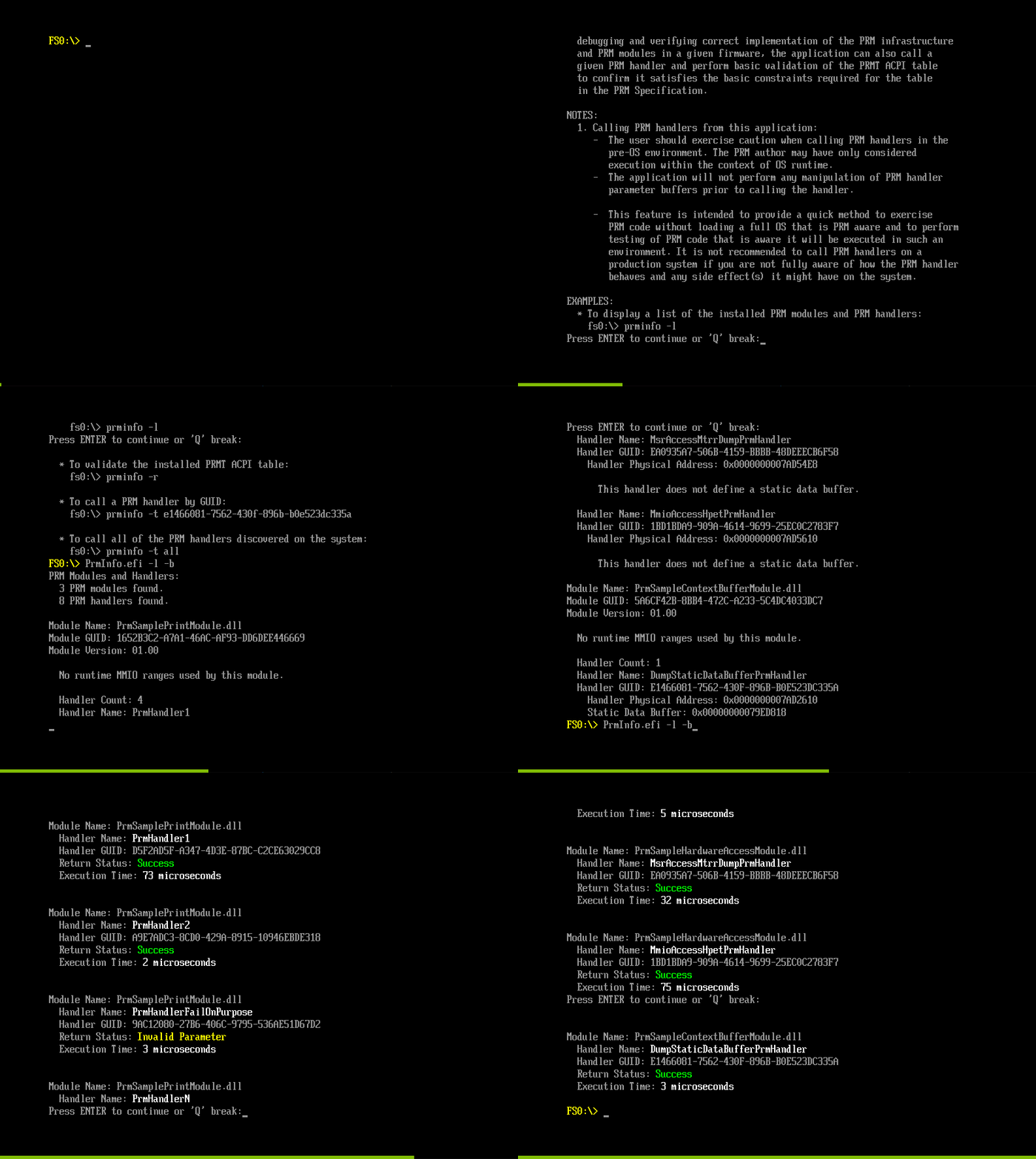 | |
| ## PRM Module | |
| > ***Note***: You can find simple examples of PRM modules in the Samples directory of this package. | |
| > [Samples/Readme.md](PrmPkg/Samples/Readme.md) has more information. | |
| By default, the EDK II implementation of UEFI does not allow images with the subsystem type | |
| `IMAGE_SUBSYSTEM_EFI_RUNTIME_DRIVER` to be built with exports. | |
| ```txt | |
| ERROR - Linker #1294 from LINK : fatal exports and import libraries are not supported with /SUBSYSTEM:EFI_RUNTIME_DRIVER | |
| ``` | |
| This can adjusted in the MSVC linker options. | |
| The subsystem type is changed in the firmware build to allow the export table to be added but the subsystem type in the | |
| final image is still `0xC` (`EFI Runtime Driver`). This is important to allow the DXE dispatcher to use its standard | |
| image verification and loading algorithms to load the image into permanent memory during the DXE execution phase. | |
| All firmware-loaded PRM modules are loaded into a memory buffer of type `EfiRuntimeServicesCode`. This means the | |
| operating system must preserve all PRM handler code and the buffer will be reflected in the UEFI memory map. The | |
| execution for invoking PRM handlers is the same as that required for UEFI Runtime Services, notably 4KiB or more of | |
| available stack space must be provided and the stack must be 16-byte aligned. | |
| ***Note:*** Long term it is possible to similarly load the modules into a `EfiRuntimeServicesCode` buffer and perform | |
| relocation fixups with a new EFI module type for PRM if desired. It was simply not done since it is not essential | |
| for this POC. | |
| Where possible, PRM module information is stored and generated using industry compiler tool chains. This is a key | |
| motivation behind using PE/COFF export tables to expose PRM module information and using a single PRM module binary | |
| definition consistent between firmware and OS load. | |
| ### PRM Module Exports | |
| A PRM module must contain at least two exports: A PRM Module Export Descriptor and at least one PRM handler. Here's | |
| an example of an export table from a PRM module that has a single PRM handler: | |
| ```txt | |
| 0000000000005000: 00 00 00 00 FF FF FF FF 00 00 00 00 3C 50 00 00 ............<P.. | |
| 0000000000005010: 01 00 00 00 02 00 00 00 02 00 00 00 28 50 00 00 ............(P.. | |
| 0000000000005020: 30 50 00 00 38 50 00 00 78 13 00 00 20 40 00 00 0P..8P..x... @.. | |
| 0000000000005030: 5D 50 00 00 7C 50 00 00 00 00 01 00 50 72 6D 53 ]P..|P......PrmS | |
| 0000000000005040: 61 6D 70 6C 65 43 6F 6E 74 65 78 74 42 75 66 66 ampleContextBuff | |
| 0000000000005050: 65 72 4D 6F 64 75 6C 65 2E 64 6C 6C 00 44 75 6D erModule.dll.Dum | |
| 0000000000005060: 70 53 74 61 74 69 63 44 61 74 61 42 75 66 66 65 pStaticDataBuffe | |
| 0000000000005070: 72 50 72 6D 48 61 6E 64 6C 65 72 00 50 72 6D 4D rPrmHandler.PrmM | |
| 0000000000005080: 6F 64 75 6C 65 45 78 70 6F 72 74 44 65 73 63 72 oduleExportDescr | |
| 0000000000005090: 69 70 74 6F 72 00 iptor. | |
| 00000000 characteristics | |
| FFFFFFFF time date stamp | |
| 0.00 version | |
| 1 ordinal base | |
| 2 number of functions | |
| 2 number of names | |
| ordinal hint RVA name | |
| 1 0 00001378 DumpStaticDataBufferPrmHandler | |
| 2 1 00004020 PrmModuleExportDescriptor | |
| ``` | |
| ### PRM Image Format | |
| PRM modules are ultimately PE/COFF images. However, when packaged in firmware the PE/COFF image is placed into a | |
| Firmware File System (FFS) file. This is transparent to the operating system but done to better align with the typical | |
| packaging of PE32(+) images managed in the firmware binary image. In the dump of the PRM FV binary image shown earlier, | |
| the FFS sections placed by EDK II build tools ("DXE dependency", "User interface", "Version") that reside alongside the | |
| PE/COFF binary are shown. A PRM module can be placed into a firmware image as a pre-built PE/COFF binary or built | |
| during the firmware build process. In either case, the PE/COFF section is contained in a FFS file as shown in that | |
| image. | |
| ### PRM Module Implementation | |
| To simplify building the PRM Module Export Descriptor, a PRM module implementation can use the following macros to mark | |
| functions as PRM handlers. In this example, a PRM module registers three functions by name as PRM handlers with the | |
| associated GUIDs. | |
| ```c | |
| // | |
| // Register the PRM export information for this PRM Module | |
| // | |
| PRM_MODULE_EXPORT ( | |
| PRM_HANDLER_EXPORT_ENTRY (PRM_HANDLER_1_GUID, PrmHandler1), | |
| PRM_HANDLER_EXPORT_ENTRY (PRM_HANDLER_2_GUID, PrmHandler2), | |
| PRM_HANDLER_EXPORT_ENTRY (PRM_HANDLER_N_GUID, PrmHandlerN) | |
| ); | |
| ``` | |
| `PRM_MODULE_EXPORT` take a variable-length argument list of `PRM_HANDLER_EXPORT_ENTRY` entries that each describe an | |
| individual PRM handler being exported for the module. Ultimately, this information is used to define the structure | |
| necessary to statically allocate the PRM Module Export Descriptor Structure (and its PRM Handler Export Descriptor | |
| substructures) in the image. | |
| Another required export for PRM modules is automatically provided in `PrmModule.h`, a header file that pulls together | |
| all the includes needed to author a PRM module. This export is `PRM_MODULE_UPDATE_LOCK_EXPORT`. By including, | |
| `PrmModule.h`, a PRM module has the `PRM_MODULE_UPDATE_LOCK_DESCRIPTOR` automatically exported. | |
| ## PRM Handler Constraints | |
| At this time, PRM handlers are restricted to a maximum identifier length of 128 characters. This is checked when using | |
| the `PRM_HANDLER_EXPORT` macro by using a static assert that reports a violation at build-time. | |
| PRM handlers are **not** allowed to use UEFI Runtime Services and should not rely upon any UEFI constructs. For the | |
| purposes of this POC, this is currently not explicitly enforced but should be in the final changes. |